
Conference in the Hague. In Search for Peace.
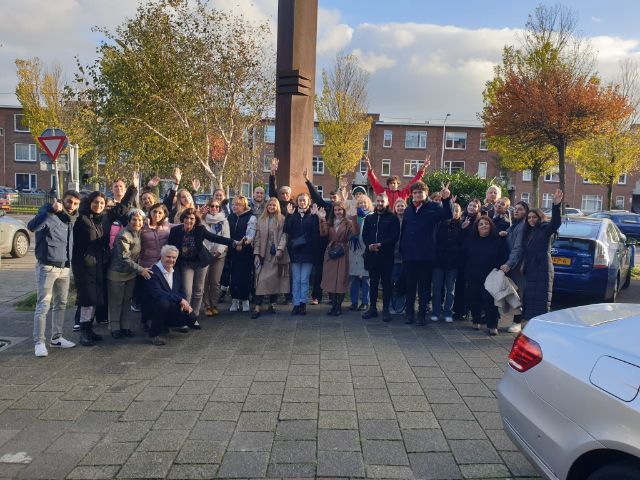 European Erasmus + program is one of the few funds which provides young people from different countries with the opportunity to independently come together and look for solutions for the problems that are important for Europe. Young people living in the EU, especially their peers living in the Eastern Partnership countries, have a need for the authorities and societies of European countries not only to hear their voice, but to take steps to implement their proposal, especially if it is directly related to youth.
Young people both from the EU and the Eastern Partnership countries have a need to discuss with each other and with experts from different countries the reasons for the outbreak of hostilities in Armenia, Ukraine and in some other countries.
In July 2023 Dutch NA approved project 2023-1-NL02-KA154-YOU-000139635, “Return to the Hague. Return to Peace." The project involved NGOs from four Eastern Partnership countries - Ukraine, Georgia, Armenia, Moldova and six EU countries - the Netherlands, Germany, Greece, Croatia, Poland and Estonia. Participants in our conference were chosen by young people - members of the initiative group from these countries. The initiative group was created during the preparation of the project.
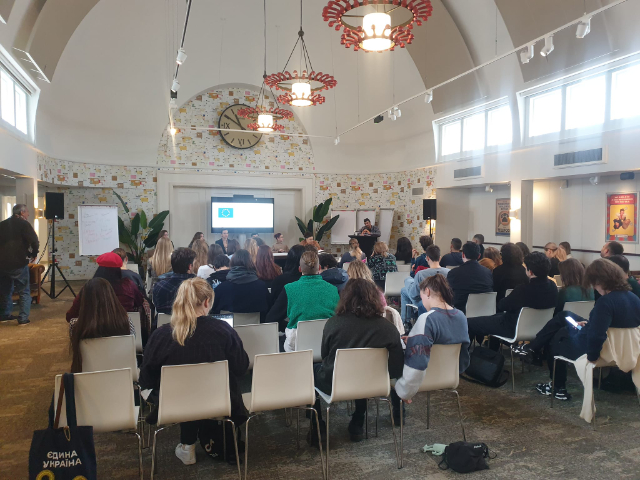 From each country, 5 young people, the head of the national team and the policymaker were supposed to participate in the conference. The project organizers asked national teams to invite government representatives or experts who have been conducting international projects for many years as policymakers.
From Ukraine, Armenia and Greece, national-level government officials acted as policymakers. In the teams of Croatia, Germany and Moldavia, the role of policymakers was performed by specialists with extensive experience working in a public environment. Unfortunately, due to another epidemic of colds, several participants were forced to refuse participation a week before the start of the conference.
The team of International Relations Development was represented by the activists of youth Armenian organizations. The first day of the conference began with a plenary session, it was a getting to know each other. The participants also shared their expectations from this conference. There was also time devoted for familiarization with European Youth Goals and Erasmus+ Youth Quality Standards. Then Geert Ates – Dutch policymaker talked about how the Netherlands views the war in Ukraine, what opportunities do young people in the Netherlands have to influence the situation in the country, and how, in his opinion, youth international cooperation can help preserve peace in Europe. Next, the participants were divided into 6 mixed working groups. The groups were given the task to discuss the understanding of European values, and how these values can help in the long-term establishment of peace in Europe.
On the second day, the conference participants visited the Armenian Abovyan Center. The hospitable hosts treated the guests to traditional Armenian food. Mato Hakhverdian, the head of the center, spoke about the work that Armenians are doing to support their compatriots in the Netherlands. He also told about the conditions in which NGOs work in the Netherlands, how the authorities and society treat them.
After the meeting, the participants split into new working groups and the new task for them was to implement the survey on the streets of the Hague about the impact of the war in Ukraine on the future of Europe. It should be emphasized that among the participants from Ukraine and Armenia conducting street surveys there were young people whose acquaintances died in the wars.
The main result of these surveys is that young people living in The Hague have heard about the war in Ukraine, they know that the war was started by the Russian leadership. They knew practically nothing about the war between Azerbaijan and Armenia. The residents of The Hague have their own, calm and moderate life. They, of course, know that in Ukraine every day cities are destroyed and people die but they have no understanding of what they can do to stop this war and they are not ready to take the initiative to stop this war.
According to the original plan, on the third day there was a meeting with the ambassadors of Armenia, Georgia and Moldova and the discussion on the causes of armed conflicts in Europe, and on the fourth day a meeting with the representatives of the European Parliament, European Commission, Council of Europe, OSCE, Ministry of Foreign Affairs of the Netherlands was planned.
We sent invitations to the responsible persons of the European Parliament, European Commission, Council of Europe, and OSCE four months before the start of the conference. The letters emphasized that in wars, as a rule, young people die the most, despite the fact that they actually have little opportunity to influence the situation so that these wars stop. We understood that sending of invitation letters was not enough. Representatives of our organizing group called these international organizations once a week and explained the exceptional importance of their participation in the conference. But... Some immediately stated that they could not participate, others promised to find out everything and asked to call later, others said that they could not find our invitation and asked to send it again and all this continued until the very beginning of the conference.
It must be admitted that the employees of the National Agency Erasmus+ were not sure from the very beginning that representatives of these international organizations would take part in the conference. If there were no wars in Europe, then such indifference to the inter-row youth conference could be understood. But tens of thousands of young people have already died in the war between Azerbaijan and Armenia. The leadership of Azerbaijan does not want to sign a peace agreement with Armenia. Armenia does not have weapons for successful defense. This means that in Armenia, war can start at any moment. Russia continues its military operations in Ukraine and has no intention of stopping. Georgia has already been in a similar situation and lost part of its territory. The Moldavian authorities are afraid that, following Ukraine, Russian troops will enter their territory. International organizations, especially the OSCE, urgently need to find new approaches to restore peace in Europe. We have no answers why they decided that our conference in The Hague would not give them anything new. You should have seen the disappointment of the participants from Ukraine and Armenia, when they learned that representatives of the European Parliament, European Commission, Council of Europe, OSCE would not be at the conference. Representatives of Georgia and Moldova were no less worried about this.
As a result, the conference organizers had to introduce changes to the program. The third day at the plenary session the policy makers of the teams spoke. They answered questions of the young participants. As expected, the speeches and subsequent discussions were quite emotional. On this day, national teams were given the task of discussing how the wars in the Eastern Partnership countries affected their lives and their country.
On the fourth day, representatives of the Ministry of Foreign Affairs of the Netherlands and the embassies of Georgia, Armenia and Moldova also took part in the plenary session. At the meeting, the teams presented the results of yesterday's task and answered questions. Many thanks to Ambassador Extraordinary and Plenipotentiary of Georgia David Solomonia for his position. He spoke not only about the position of the Georgian government regarding the military conflict, but also the prospects for the development of the Eastern Partnership Program and answered numerous which participants asked.
The last day of the conference was devoted to evaluating the results of the conference. The participants also had to come up with ideas on what should be done after the completion of the project. At the beginning, those who considered the results of the conference as a whole unsatisfactory were invited to the podium of the conference hall; there were none of them among the participants. Then those who considered the results of the conference to be satisfactory, good and very good were invited in turn. At the request of the organizers, all participants explained in detail why they chose this assessment, told what they liked and what they didn’t, and said what, in their opinion, should be done so that politicians and the international community hear their voice.
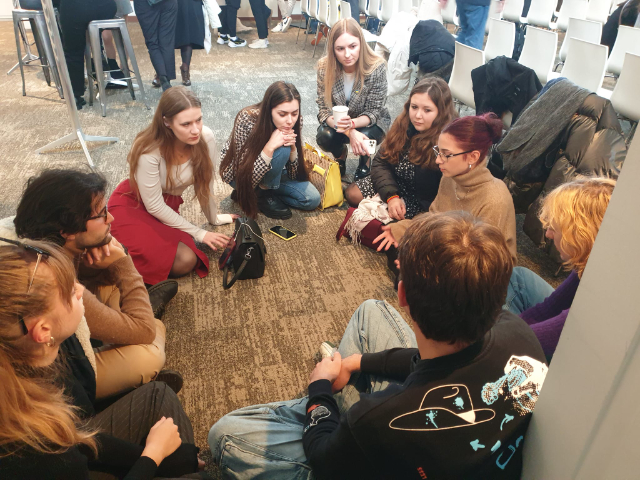 The number of participants who rated the overall results of the conference “excellent” was only two, but these were Thanos and Alexis from the Greek team, young people who participated and themselves organized quite projects under the Erasmus+ program. Their assessment was especially important to us. Approximately 70% of the participants rated the project positively, the rest rated the project satisfactorily.
The entire Ukrainian team rated the project “satisfactory.” The conference participants, including the Ukrainian team, lived in the very center of The Hague, where, despite the pereodic rain, it was an endless holiday. Restaurants and cafes in The Hague were crowded, tourists from all over the world walked and had fun all night. The participants really liked the Netherlands. However, a day later the Ukrainian team had to return to another reality, where bombs fall every day and people die. Ukrainian participants expected that representatives of the European Parliament, European Commission, Council of Europe, OSCE would take part in the conference. They wanted to tell them about the horrors of war that they see every day. They wanted to offer solutions that, in their opinion, would help to end this war and punish those who started it. However, the representatives of the European Parliament, European Commission, Council of Europe, OSCE did not come to the conference… In their speeches, most participants indicated that project showed that the Erasmus+ program can become a cross-cutting tool so that young people from different European countries can discuss issues that are important for the entire continent. Recommendations created by national teams are also an important result. The Armenian team believed that if the European Union and the United States had prevented the war provoked by Azerbaijan's totalitarian leadership against Armenia, which had embarked on a course of democratization, in 2020, the Russian authorities would not have dared to start a war with Ukraine. Therefore, countries that have chosen a democratic path of development should be supported not only with promises but also with action.
We are very grateful to the National Agency Erasmus+ for deciding to finance our project. In fact, they gave us a chance to prove that young people can not only heroically die in a war that was not started by young people, but also take real steps so that such wars do not happen on the European continent. Now it is important that the seriousness of these steps are to be recognized by those who decide the fate of Europe. The organizing committee sent recommendations to the European Parliament, the European Commission, the Council of Europe, and the OSCE, developed by the project participant, on what should be done to prevent military action in Europe. The Armenian team returned from The Hague with mixed feelings. The Netherlands is one of the freest and most developed countries in the world, and it was a great joy to not only be there for five days but also to actively interact with young people from other countries. However, the threat of an attack by Azerbaijan and Turkey on Armenia is very real. And Russia's war with Ukraine is becoming more brutal by the day. This means we all have a lot of work to do to stop the fighting and the deaths of young people in Europe.